








St. Ralph Sherwin Catholic Multi-Academy Trust (SRS CMAT) operates 25 academies, principally in Derby, and Derbyshire. It was formed on 1st September 2018.
8 years later it is on the verge of bankruptcy amongst much controversy.
Parents are upset, teachers being made redundant, Governors being sacked, suppliers not being paid and children losing their education. How is an organisation, backed by the Nottingham Roman Catholic Diocesan Education Service and the Bishop of Nottingham, in such a terrible state.
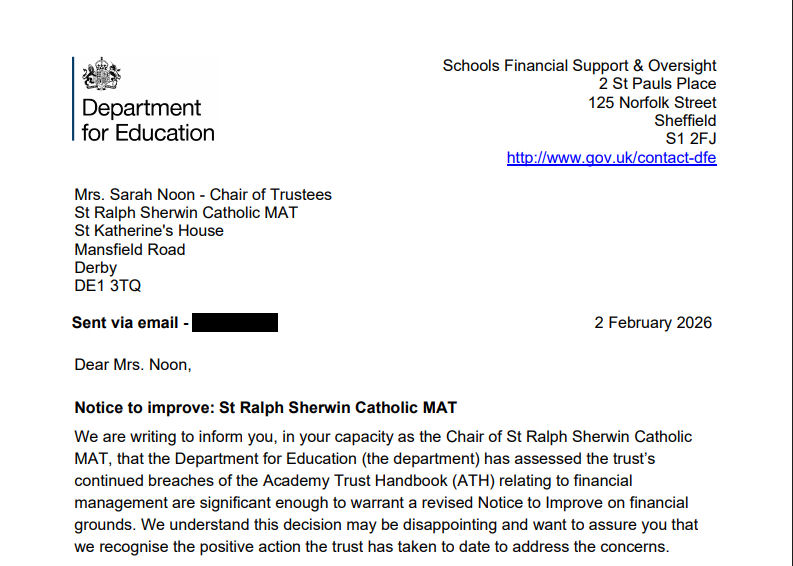
On 11th August 2023 the Trust was issued with a Notice to Improve by the Department for Education (DfE) due to its concern over the financial management of the Trust. Following “continued breaches of the Academy Trust Handbook”, a further Notice was issued on 2 February 2026.
In the accounts for the year to 31st August 2025, the CEO , Kevin Gritton stated:
“I confirm that the following instances of material irregularity, impropriety or non-compliance have been
discovered to date and have been notified to the board of trustees and DfE. If any further instances are identified
after the date of this statement, these will be notified to the board of trustees and DfE”
The irregularities were:
- Unapproved £200,000, interest free loan from the Nottingham Catholic Diocese, with no fixed repayment term
- Unapproved severance payments to staff
- Incorrect use of Capital funding to fund operational activities and cash flow – £1.9m
- Unapproved related party transaction with another Nottingham Diocese Trust.
The Trust’s cumulative operating deficit of £9.2m is the largest reported by any English Academy Trust
It was only in January 2026 that parents became formally aware of the seriousness of the financial crisis
How does the Trust explain their financial situation?
The Trust published a Frequently Asked Questions (FAQ) document for Parents on 15th May 2026 . Section 1 of the document ( Financial context) gave the underpinning rationale for the problems:
“Funding challenges…are due to a number of factors, including partially funded pay rises, a drop in pupil numbers and a rise in overall costs”
“Drop in pupil numbers”
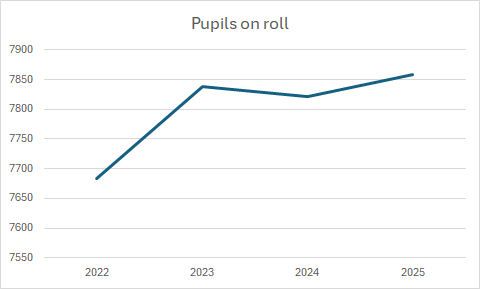
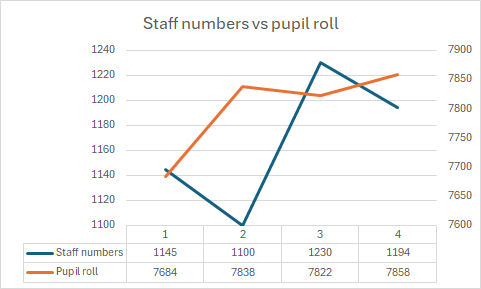
The funding formula for Trust income is directly linked to the number of pupils. The published accounts show that in 2022 there were 7,684 pupils INCREASING to 7,858 by 2025, contrary to the Trust’s recent statement
“Partially funded pay rises”
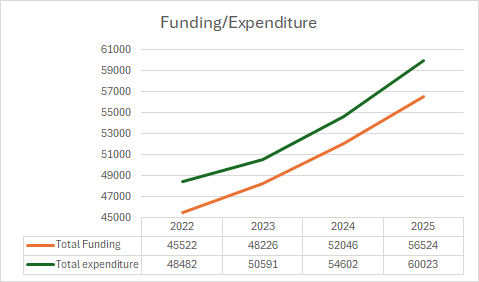
From 2022 to 2025, the income per child increased from £5,920 to £7190 pa – a 21% increase. Total staff costs in the same period increased by 14%; the average pay increased by 9%. Overall expenditure per child increased by 21%.
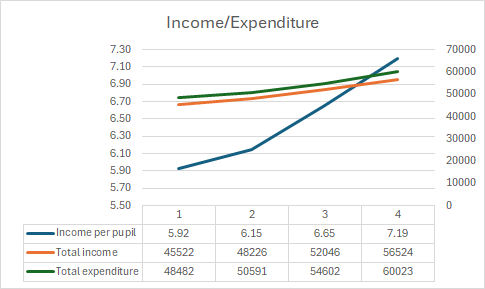
The chart shows that income is tracking total expenditure – but consistently above income. This would suggest that pay rises are being funded.
Staff costs average 87% of total income; DfE benchmarks are 75%, implying that the issue is too many staff, rather than the pay rises being unfunded.
“Staffing levels have remained higher than the Trust could afford”
Pupil numbers have increased over the last 4 years. Staff numbers relative to the number of pupils have increased proportionately.
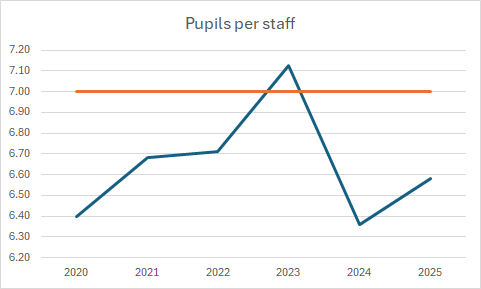
However, the DfE benchmark level for the number of pupils on roll per staff member, is ~7 for a Multi-Academy Trust of this size ( some being as high as 8). SRS CMAT achieved this in 2023 when staff numbers were at 1100. In 2023, an additional 130 staff were recruited (12% increase) despite no increase in the number of pupils. This sub-benchmark level has continued into 2025.
The FAQ document proceeds by stating that
“The deficit has arisen from a widening gap between income and expenditure. Falling pupil numbers have reduced funding while pay awards and inflationary pressures have increased costs at a faster rate than school budgets have grown“
The FAQ’s has a section “What other cost-saving measures are being considered?” which, in summary are:
- Alternative Trust office accommodation
- The Trust occupies the 3rd Floor of St Katherine’s House which is currently being marketed at £30k pa rent. This represents less than 1% of the Trust’s annual deficit.
- Research suggests that the SRS CMAT doesn’t pay the rent and that it’s currently paid for by the Nottingham Diocese.
- Renegotiating service contracts
- SRS CMAT is funded by public money so should already be adhering to best procurement standards of obtaining 3 quotes, transparency etc. This initiative is unlikely to make a difference
- Alternative forms of income
- Expanding lettings – likely to be limited as most of the properties are owned by the Diocese
- Access external funding opportunities – possible?
- Investing “daily surpluses” of cash in short-term high interest accounts – as the Trust has no money this is not viable, also there is no such thing as short-term, high interest rate accounts
- Land sale opportunities – at best, this is a one-off cash injection.
Comment / Opinion
A 25 Academy Trust that manages its £50m budget through a spreadsheet is always going to struggle to understand and control its finances. In Qtr 3 2025 it finally implemented an accounting system however that will take time to fully migrate without errors and be a source of insight. Since its inception in 2018, the Head Teachers in the Trust have not had detailed access to their operational finances; they have been dependent on the services of the Central Trust team.
It is evident from the Trust’s FAQ document that they do not understand their finances, at all, and are relying on convenient excuses to justify their draconian actions.
The most desperate “cost-saving measure” in the FAQ document is:
“Working with each school individually to understand local issues and find solutions that remain within budget”
This is a Trust that has no plans to solve their deficit problem.
It is plain that:
- There are too many staff.
- In 2023 the staffing level was in line with a national DfE benchmark. Why did the CEO and the Trustees sanction a significant increase in headcount which was unaffordable and unnecessary?
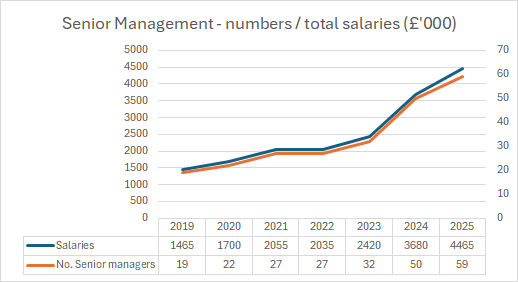
- In the 2 years, 2024 and 2025, the number of pupils increased by just 20 (0.25%), yet staff increased by 194 (17.6%) with around 20 being on a salary greater than £60k pa
- Non-staff costs are not being controlled
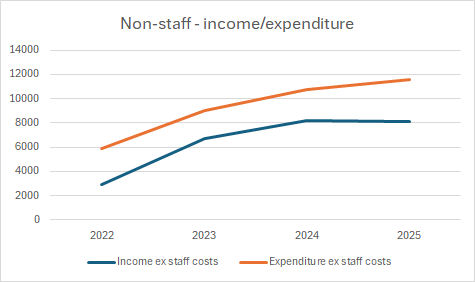
- Between 2023 and 2025 non-staff costs increased from £9.1m to £11.6m (£2.5m) with no increase in pupils. The Trust should be examining where every penny of the £11.6m is being spent
In 2023/2024 the DfE (Education ans Skills Funding Agency) lent the Trust, £468,000 referred to as “cash flow loan”. In 2024/25 the Nottingham Diocese made a similar “cash flow loan” of £200,000. It would have been obvious to all that the Trust was hemorrhaging cash, but did nothing about it
In 2023 when the Trust received its first Notice to Improve and was running a £2.5m operating deficit, it should have made substantial changes to “balance the budget”, by:
- Stopping recruitment – not significantly increasing the headcount beyond a sustainable level.
- Stopping any unnecessary expenditure , not increasingt beyond historic levels.
- Implementing an accounting system that could professionally manage an organisation of this size.
Had this action been taken then it would not have accumulated a £9.2m deficit, and would not have needed to take drastic action to cut costs. There would have been no strike action, no upset parents, and most importantly, uninterrupted education for the children
There is a fine line between reckless incompetence and fraud but the Chief Executive Officer, and the Trustees had everything at their finger tips to make the right decisions, at the right time, but they chose not to.
Please Share this Post, thank you...

Categories: Uncategorized


Absolutely spot on commentary. Teachers, ex-teachers, and heads should have no place in the business management of any educational facility. Unfortunately, this is the case in most academies and trusts. This mess precisely highlights the risks of hiring the wrong people in senior management positions in education. Heads and ex-teachers should not even be considered for such critical business-focussed roles. Whether you like it or not, like most public services, you must have a high level of business aptitude and experience in your senior management teams.