








A casual observer of Derby City Council might be confused about the state of its finances.
Just 2 years ago, the Council was predicting a £10m deficit on £272m income for 2024/25. Now it is budgetting for income of £306m ( an additional £34m – 13% increase) with costs now being £305m ( an additional £23m to the plan for 24/25) – this is on top of previously expected inflationary/demand pressures.
So a predicted £10m deficit has now morphed into a plan to break even.
Do Officers really understand what drives the Council’s finances?
Where does the money come from?
Of the £306m for 24/25, only £125m comes from the Council Tax, the rest comes from Business Rates (£61m) and the balance (£120m) comes from various Central Government grants.
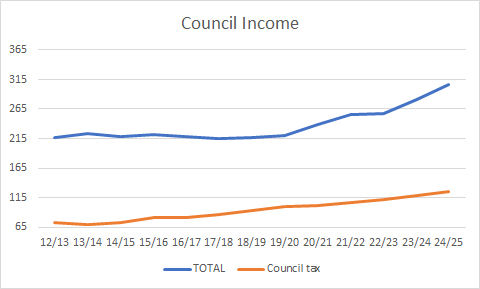
Over the last 6 years, the percentage of the income from Council Tax has reduced from 45% to 41%. Council Tax annual rises are restricted to a maximum of 4.99% pa (including the Adult Social Care precept) so any spending gaps can only be covered by Central Government grants.
The chart, above, shows a marked increase in the overall income to the Council in the last 5-6 years. Despite this spending has exceeded income over that period which has resulted in the £30m+ depletion in revenue reserves.
The income keeps increasing
Each year the Council plans 3 years ahead. Inevitably, the further out the forecast, the more unreliable it becomes.

In just 2 years, the expected income for the Council in the 2024/25 year has increased from £272m to £306m; an increase of £34m, of which, only £3.5m is due to Council Tax. The balance of £30.5m is from an additional £37.5m from Central Government offset by a £7m reduction in Business rates. The implication of this is that the credible planning horizon for Derby City Council is less than 2 years.
This level of income growth is necessary to cope with an ageing population requiring more Social Care, an ever increasing population of children requiring special educational services / care, and inflation.
Budgetting for Children’s Services
Derby News has been very critical of the Council’s budgetting for Children’s Services in the past.
Derby City Council Budget : 8 Questions that Councillors should ask
Council understates Children’s Services budget by £6m…again!
This has proven to be a valid concern.
In Dec 2021 the Council planned on spending £76m in 2024/25 on Children’s Services, which included no growth from 2022/23, despite an historical increase in spend, year on year ( see chart below). The current plan for 2024/25 is £89m – £13m higher than the “plan” published 2 years ago – a 17% error! This is broadly consistent with the Derby News chart in the above articles.
A straight line budget based on an historical trend would have been more accurate than the Council’s existing “process”.

Improved budgetting
The Council’s archaic budgetting process burdens the finances with “pressures”, seemingly irrespective of their actual likelihood, with a mathematical consequence that “savings” must be identified. In last year’s budget there were 166 different savings ideas ( “salami slicing”) many were very small and therefore unmeasurable, and many so vague as not to be deliverable.
The Derby News article from 18 December 2022 commented:
“Why is the Council not planning “transformationally” based on the Themes presented a year ago in the Council Plan; it has reverted back to the much maligned “salami slicing” approach to cost savings?”
In the 20 December 2023 Cabinet paper, a new approach has been followed:
“4.2.2 Delivering a sustainable Council will not be achieved through continued ‘salami slicing’ of services. The Council has an on-going duty to deliver value for money services, but the so called ‘low hanging fruit’ of savings opportunities, have long since gone.
A continuous drive to be as cost effective as possible, will now only be achieved by creativity and innovation. The Council’s strategy to achieve this is through the launch of the Delivery Board
Savings and AI
The 2024/25 budget still does rely to some extent on “salami slicing”, however it has also focussed on a potentially high risk strategy – the implementation of AI ( Artificial Intelligence). Of the £8.4m savings required in 2024/25, £3.9m ( 46%) will rely on some form of AI being implemented. The vast majority will be in Adult Social Care – £3.2m.
- AI and Occupational Therapy led reviews of community care packages. £2.9m
- Use of AI to reduce the need for residential placement – keeping clients in the community £0.125m
- Use of AI – outbound proactive chasing of financial debt. The solution is anticipated to generate improved recovery of the existing debt. £0.21m
The Council’s first experiments with AI was with the “Digital Helpers” – Darcie and Ali (Ally). A previous article questioned how useful the Ally “helper” is, especially for callers who are homeless.
Derby City Council’s digital helper “Ally” complicates life for homeless callers.
Darcie is a “front end bot” that amounts to a “search engine”. Ask Darcie about being homeless and it informs the person to ring the central phone number which is then answered by Ally; this “barrier” has to be overcome to speak to a real person. Alternatively Darcie advises a visit to the Council’s Homelessness web page, and then to the same phone number which reaches Ally. – no real beenfit to anyone!
Comment
There is no question that the Council needs to think transformationally and to make change it needs to be innovative, and to take risks. Short-sighted, punitive cutting, with little consideration for the unintended consequences, which has been the strategy of choice for many previous administrations, is never the right way forwards for the City; the ill-fated Library strategy is a case in point.
Around 65% of the Council’s non-Schools budget is spent on Adult Social Care and Children’s Services. By its nature, each case, and interaction is unique to the child and adult involved. It seems unlikely that this will lend itself to AI which relies heavily on large quantities of system based data and algorithms for its predictive behaviour modelling.
It’s not evident that the Council understands the issues behind the growth in Adult and Children’s services. Consistently budgetting for zero inflation in Children’s Services shows that it has no basic grasp of the underlying subject.
Whilst it’s a good strategy to explore ways in which new technology can help the Council, this feels to be far too visionary, at the moment, for it to deliver in the next 12 months. I suspect that, in the short term, the Council will benefit from good, old-fashioned, human intelligence to analyse and think carefully about the critical cost drivers and how to avoid wasted efforts.
However, Senior Council Officers are too heavily invested in maintaining the status quo, and surrounding themselves in the comfort blanket of spurious complication and specious legalities to be truly challenging of themselves?
The Council needs a few “disruptors” to unsettle those in cosy positions and develop ways to take cost out of the whole system and not just transfer the effort from the Council to the Tax Payer.
Please Share this Post, thank you...

Categories: Uncategorized

 Derby News
Good factual reporting on the budget but I think you need to expand and have more of an argument to back up the title than just your assertion in the last paragraph