






Just a few weeks ago the Council published a headline statement that next year’s budget would show a deficit of £34m.
It transpires that the number only contained part of the story and didn’t take into account any “savings” which are a routine, and misleading, part of the Council’s opaque budgetting process, or new funding that had been announced in the Chancellor’s Autumn Statement on the 17th November.
The 52 page Medium Term Financial Plan (MTFP) or “Budget” document will be discussed at the Cabinet Meeting on the 21st December. It contains a lot of detail, most of which only serves to obscure some key points which should prompt questions from Councillors and residents. These are:
Council Tax
Prior to the Autumn statement all Councils could increase Council Tax by a maximum of 2.99% (1.99% General Council Tax and 1% for Adult Social Care). From 1 April 2023 Councils can now levy a total increase of 4.99%.
The Medium Term Financial Strategy Summary ( published 7 Dec 2022) s 4.4.2 stated that the increment associated with the new Council Tax levels would be £2.246m. The Budget only adds in £1.115m
Why has the funding from Council Tax been understated by at least £1.131m resulting in unnecessary cuts to services?
Adult Social Care Funding
On 17th November the Chancellor announced additional money for Councils in 2023/24 of £1bn for Adult Social Care – the additional grant is over and above the Adult Social Care levy in the Council Tax. No details have been issued as to how this is split by each Local Authority.
The Budget includes £11m in 23/24 and £17m in subsequent years – this is a new grant for 23/24. Had this not been announced on the 17th November 2022 – the Council would have been in deficit by a further £11m
“There has been no announcement yet of any further burdens associated with this funding. The MTFP assumes that this will be distributed on a basis that recognises resource equalisation for low tax base Councils”
para 4.5.4 Medium Term Financial Plan 2023/24 to 2025/26 – Update and proposed Consultation 21 Dec 2022 (MTFP – Medium Term Financial Plan)
The £11m is an assumption – it could be higher, or it could be lower
NB: The net total increase in Adult Social Care in 23/24 is just £6m. The Council is therefore subsidising other services by £5m, by cutting back on care packages for elderly and vulnerable people.
What is the risk that the new £11m grant could be substantially lower and undermine this budget plan?
Why is the full £11m not being used on Adult Social Care support?
The majority of the “Pressures” in the Budget are not related to Cost of living / energy price inflation.
Appendix 3 of the Budget document pack details all of the emerging pressures since February 2022 – this totals £27.9m. 90% of this total is covered by just 10 line items.
- £2.5m – Electricity / Gas inflation
- £9.4m – Pay inflation – including the 22/23 overspend due to poor planning in the previous budget [budgetted in 22/23 for 1.5% pay rise ; actual ~5% . Planned ~4.5% for 23/24])
- £3m – predictable growth in Adult social care demand given known demographics.
- £4.5m – predictable increase in demand for Home to Care Transport due to the Council placing children in out of area schools without taking into account transport costs in the decision making process.
- £4.5m – predictable growth in residential costs for Children in Care
- £1m – predictable increase in carer costs associated with Children being permanently placed
There is a myriad of other technical/discretionary pressures making the balance which should be mitigated through normal business, or avoided, without the need to over-escalate them into a formal “Budget Pressure”.
Some notable examples of other pressures:
- £3.07m – Treasury Management requirement to fund borrowing – could it be re-phased/restructured?
- £0.58m – Advance Cyber Defence of the Council
- £0.55m – Members allowance 5.4% increase in line with the 22/23 pay award
- £0.5m – Reversal of previous planned review of waste collection service.
- £0.278m – Unified Telephony (Teams, Office and Call Centre) – phone exchange for people making external calls
- £0.15m – Analog to digital switch-over of telephony lines
- £0.1m – Legal costs – external barristers fees in complex cases. (Legal costs to avoid providing appropriate educational support for Special Needs Children)
- £0.177m – Market Hall mobilisation expenses.
- £0.02m – Events – Cycle Race tour series
Why has the Council not, previously, earmarked reserves in advance, for known growth in statutory services?
Is the Council asserting that none of the Pressures in the budget can be avoided/deferred and that all are of a higher priority than supporting vulnerable people?
Children’s Services
The 4 items highlighted in RED above are described as being pressures for 23/24
In my article of 27 February 2022 “5 Reasons why Councillors should reject this “travelling hopefully”Budget”” the following chart (updated) predicted that the Children’s Service Budget for 22/23 should have been around £82m and not £75m. This was based on historical growth ; the Local Government Association also suggested a much higher number to the one used in the Budget
The forecast outturn contained within the Council’s Qtr 2 22/23 Forecast is £84m due to an escalation in the cost of placements and home to school transport. It would be reasonable, in a growth environment to, at least, set the budget at a figure higher than the prevailing actual cost unless there was a substantial reason for assuming it would be less.
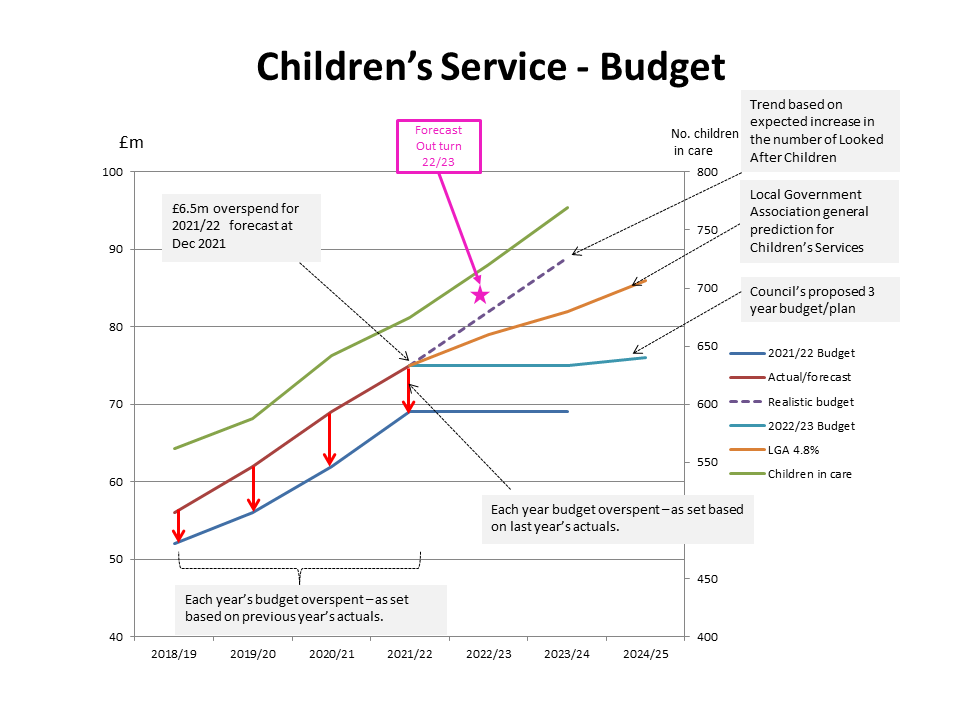
The Council has planned a budget of £81m for 23/24 – a £3m reduction on the previous years actual. The most likely outcome for next year is nearer £90m. As this is a statutory duty then the Council must provision for this cost.
Why has the Council not budgetted for the most likely outcome for the Children and Young People Budget of around £90m?
Incredible Savings
The Council convinces itself that it plans, monitors and delivers savings.
In the budget for 23/24 – there are 166 line items delivering £16.544m of savings – each idea averaging £0.1m. Every idea has to deliver 100% of its target.
Each one will have to be a separate project, to be planned and resourced. There will be risks and most importantly, unintended consequences. As there is no overarching strategic approach to cost reduction beyond the “salami slicing” of every budget there can be no assurance that one saving doesn’t create a cost somewhere else.
The 2022/23 Budget set in December 2021 presented the savings more strategically within the 4 “cross cutting” themes defined in the Council Plan, presented on the 8th December 2021 :
- Green Derby
- Vibrant Derby
- Growth Derby
- Resilient Derby
The vision laid out in the Paper stated:
Alongside a new Council Plan, the Council intends introducing a portfolio and programme management approach to shape the delivery of services across Council departments, and with Partners. Programmes will be centred around cross-cutting priority outcomes such as ‘lower carbon emissions’, ‘a diverse cultural offer’ and ‘reduced inequalities, with healthier residents’.
During 2022/23, it is planned to transition into new ways of working and reporting based on this approach. This will ensure the alignment of our strategic and operational planning and delivery, maximising our resources and time to making a difference in our shared priority areas
This seems to have fallen by the wayside – the plan is no longer structured around the themes – the word “Green” doesn’t appear once in the report. Yet the report committed:
The budget proposals to be issued for consultation will be categorised into these themes and represent the beginning of a series of interventions and transformation that will allow the budget to be better aligned to the priority outcomes over the course of the Medium Term Financial Strategy
Why is the Council not planning “transformationally” based on the Themes presented a year ago in the Council Plan; it has reverted back to the much maligned “salami slicing” approach to cost savings?
Is the Council confident that all savings don’t result in a consequential cost elsewhere in the Council. Has each proposal been risk assessed?
Comment
This is a “Panic” budget ; it is not based on any degree of strategic thinking – there is no underpinning leadership or direction. It is the outcome of years of poor planning with little in the way of transformational thinking. Too much of it is reacting to events.
I referred to last year’s budget as “Travelling Hopefully” and that is exactly how it has turned out – with massive overspends forecast. This coming year will be no different.
“5 Reasons why Councillors should reject this “travelling hopefully”Budget””
The rhetoric of the “Cost of living crisis” will cut through, with many, as enough justification for the wide ranging cuts to services. In reality very little of this mess is due to that.
One of the major pressures on the Children and Young People budget relates to Post-16 Home to School Transport. My previous article (Home to School transport for vulnerable children to be cut by £3m due to Council’s poor planning) highlighted that this is largely based on incompetent management of the process within the Council and no sharing of information ; had that taken place then more informed and cost effective decisions could have been taken. It is nothing to do with the cost of living crisis!
The Council’s Senior Officers conveniently rely on being a victim of circumstances and lean on lame excuses as an attempt to divert attention away from their incompetence in managing this City’s finances.
Derby needs credible Leaders. Being born in Derby doesn’t mitigate incompetence.
Derby deserves better!
Please Share this Post, thank you...

Categories: Uncategorized

 Derby News