







The Director of Finance’s statement in Derbyshire County Council’s “Revenue Budget Report 2024-25″said:
“The Council is required by law to set a balanced budget for the upcoming financial year. This balanced budget must be based on sound and sustainable assumptions about income and expenditure, the delivery of savings and use of reserves”
The operative word being “sustainable”
Further down he comments that between 2022 and 2025 – £148m had been taken out of Earmarked Reserves including £72m in the current financial year, and £21m for 2024/25, just to “balance the budget”
“This is not sustainable and the Council must deliver on the transformation of services, demand management and other efficiencies, to ensure future financial sustainability”
Recently, Derbyshire County Council has had a poor record on delivering planned savings and achieving its budget. It is carrying £13.544m in “undeliverable prior year savings” – savings that were necessary to “balance the budget”.
In order to achieve the proposed budget for 2024/25 ( which still requres £21m from reserves) it plans to save £40m across a range of services.
Reserves
The Council has 2 main revenue reserves which can be used to absorb overspends; at 31 March 2023 the balances were:
- General reserve – £32.7m ( this should always be in the 3-5% range for financial sustainability which this is)
- The £34m overspend in 23/24 would have wiped this out, however it will be recovered from a transfer from earmarked reserves.
- Earmarked reserves – £272.4m ( reserves set aside for a specific reason)
- £59m will be transferred out to cover overspends / budget gaps
- The total balance at 31 March 2024 is planned to have reduced from £272.4 to £142.9m – assuming no further overspends.
- By 2027 it will be down to around £85m.
The consequence of routine overspending of this magnitude is that it has to be covered by borrowing.
Borrowing
In 2023/24 the Council has overspent on debt charges by £10m principally due to interest payable on short term loans. Part of this was due to interest rate increases and the rest is due to the £57m payment to cover the legal settlement on the Derby and Derbyshire Waste Treatment Centre (Sinfin Incinerator).
The “Capital Programme Approvals, Treasury Management and Capital Strategies for 2024-25” points out that the £57m
“…is a necessary cost attributable to bringing the waste treatment facility into use, and therefore it is proposed that this expenditure is capitalised in 2023-24.
The original plan was to take this from Earmarked Reserves which would have resulted in a further unsustainable depletion. The County has defined this project as “live” to justify the policy to capitalise the expenditure, however the Labour administration in Derby City Council has a clear policy that the Incinerator will never be opened for business. There is a risk that the Council’s auditors will insist that this amount is written off against reserves.
Savings
To ensure that reserves are not depleted any further the Council needs to deliver £40m of savings over the next 12 months. Good practice would suggest that cost reduction proposals are substantiated by specific measures and plans that define a project against which an outcome can be achieved.
The following are planned to deliver £22.265m of savings with little detail in the budget report:
- Charging Policy for People Receiving Adult Social Care Support in the Community £9.753m
- 3% vacancy factor to reflect expected proportion of vacant posts due to staff turnover £6.912m
- More efficient and effective spend on support and services to families £3.5m
- Review posts across Children’s Services for efficiency savings £2.1m
A further 78 “ideas/projects” have been listed which deliver the remaining £18m with an average saving od £0.23m each.
There is nothing stated in the Cabinet papers that the Council has any form of project management structure in place to ensure that this number of projects will be delivered.
The Council’s deteriorating financial health

The revenue reserves provides the buffer, and smoothing, between the good and bad years. As overall budgets increase then an upwards trend in revenue reserves would be better. The position after 2024 assumes that all savings are delivered and there are no overspends.

The COVID years saw generous grants from Central Government which many Councils used to bolster reserves. The 2020 number which predominantly predated the 1st Lockdown was showing a transfer from reserves – that trend continued after COVID from 2023 onwards. 2025 and 2026 is the Council’s optimistic forecast but still represents a depletion.

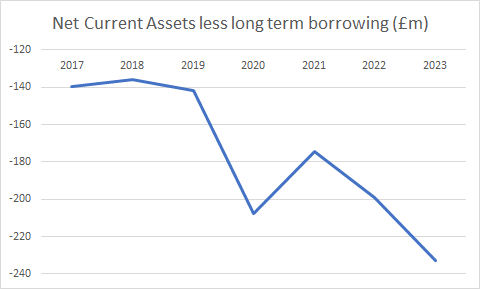
Net Current Assets is a good indication of the Council’s short term liquidity. The graph shows a clear downwards trend with a brief hiatus helped by the COVID “bounce”. As 2024 will see £30m+ taken from reserves and a £57m short term loan to cover the “estimated fair value” of the Sinfin Incinerator, then this line will dip well below zero into a position of short term illiquidity; unless this is covered by long term borrowing.
It’s interesting to note that the £57m payment re: the Sinfin Incinerator, which will be capitalised (long term asset) to avoid it deteriorating revenue reserves, is funded by a short term loan and not a term more consistent with the life of the asset.
Comment
Derbyshire County Council’s finances are in free fall.
It balances its budgets in name only relying on reserves to pass the legal test which is, fundamentally, not a sustainable way forwards. By all measures, the trend is downwards.
In the period from 2017 -2019 the Council was in receipt of some significant one-off grants which flattered the finances; this continued during the COVID period. This clearly created a period of prosperity while many other Councils were experiencing austerity. While other Councils were driving through stringent efficiencies, Derbyshire County Council remained bloated. This is evidenced by the long list of savings for 2024/25 which should have been delivered years ago.
Councils are rarely agile organisations, largely staffed by people who have made careers in just Local Authorities bathed in a Council culture which doesn’t inspire routine efficiency. The changes necessary to stop Derbyshire County Council hurtling towards formally going bust should already have been implemented.
The Council will not save £40m this year, it will soon get to a point where it cannot pay its bills without more borrowing.
There should be challenging questions over whether the proposed budget for 2024/25 is legal – it’s certainly not sustainable!
Please Share this Post, thank you...

Categories: Uncategorized

 Derby News
What a really poorly written article where the bias and narrow understanding of public sector financing particularly that related to local government comes shining through. There was a real opportunity here to discuss the wider challenges being faced by public sector organisations through a punitive funding regime. Is it only DCC that is having problems ? No these issues are widespread across many local authorities under different political control but this matter is not even mentioned never mind any critical analysis. Have local authorities suddenly en-masse become poor at managing their finances …….no again not mentioned. It’s a bit like the sub postmasters situation had hundreds of them suddenly become thieves? Local authorities have lost £bns since 2010 which represents a funding cut of in excess of 40% at a time of rampant inflation increases in fuel costs, increases in borrowing costs and massive increases in the demand for ever more expensive statutory services but again no mention of this catastrophic funding regime on the ability of local government to effectively manage their budgets. Perhaps a look and analysis of the funding formula for local government would have been helpful. That would show how this favours Counties in the South of the Country this has been a problem for many years and the impact is cumulative.
On a wider point these funding issues do not just relate the local government austerity has left the NHS the judiciary/courts and other public sector services on their knees
The summary is where the article hits new levels of bias using lazy tropes about employees of the Council to launch a thinly veiled suggestion that they are somehow the only people to blame for the problems. Many employees of the Council are working very hard in difficult circumstances to deliver critical and statutory services to our vulnerable population many working many hours above their contracted hours for no pay. Again no recognition of their efforts.So all in all a very poor limited attempt to discuss the issues at hand