







Next week the Council will publish its draft 2023/24 budget for consultation. This is the annual process which concludes in February when the Council approves the finalised document. The initial indications are that there is a £34m deficit, however a Local Authority cannot agree an unbalanced budget – it leaves the Chief Finance Officer with some difficult decisions.
Many will say that this is inevitable after years of Tory Government cuts however there is a basic flaw in this argument; in all previous years the Council has produced a balanced budget. This means that the Council’s spending plans were fully funded by a combination of various Government grants, Council Tax , Business rates and “savings”.
The specific Revenue Support Grant was reduced over time but that was offset by increases in Business Rates, Council Tax and other central Government grants. How much of that actually affected core services and how much drove the Council to be more cost effective is a moot point.
For context. In the 8 years from 2010 – 2018 the total funding (exc schools) was flat at ~ £215m pa. 4 years later in 2022/2023 it was £260m – a 21% INCREASE in 4 years.
The irony is that during the Council’s Labour administration under Banwait, reserves grew steadily each year – since 2018 all of that buffer has evaporated, despite increased funding.
The Tory administration’s strategy has been to balance the initial budget by drawing on reserves. This has been challenged on a number of occasions by the Labour leader of the Opposition, Cllr Shanker. The Chief Finance Officer has reassured all Councillors that balancing the budget by drawing on reserves is “legal”.
The other arm of the strategy is to make planning assumptions that are far too optimistic. I have written on many occasions about the errors in budgetting for the growth in Children’s Services. In short, the Council assumes each year that the new budget will see no growth from the previous year’s forecast actual outturn despite evidence to the contrary. Year after year this proves to be wrong, and each year the Council overspends by ~ £6m.
Council understates Children’s Services budget by £6m…again!
In this respect I am drawing a difference between the financial planning for Children’s Services ( which is a matter of direction from the Chief Finance Officer) and the delivery of the Service which is largely dictated by statutory responsibility. As a “Corporate Parent” the Council has no choice but to act. Much work has been done over the last few years to improve the service.
Children’s Services cost ~ £75m which is 30% of the Councils net budget – Adult Social care is 45%. In total the statutory Social Care services and associated activities represent 75% of the budget.
An unrealistic budget simply delays the inevitable point of overspend and a further drain on reserves.
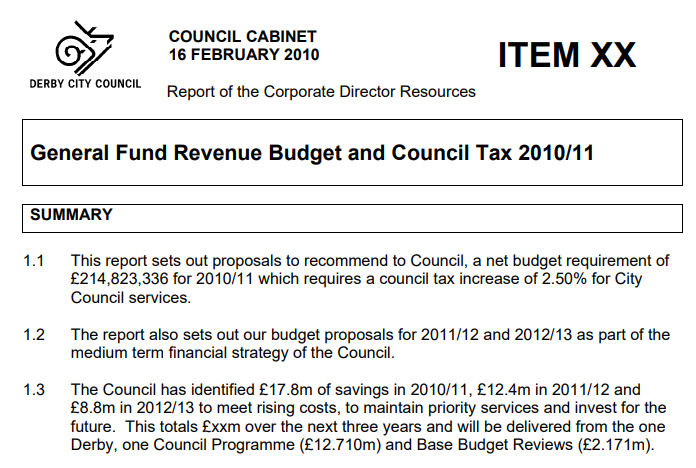
The Council’s budgetting process always results in the need to generate savings irrespective of the Government funding situation. The budget just prior to the start of the national Tory/Lib Dem coalition government (May 2010), and the subsequent years of austerity, required £17.8m of savings with further cuts in future years. This was under the last Labour Government’s funding formula.
It’s clear that the process is misleading.
COVID was a lifeline for the Council and not a financial threat. The £30m+ grants given to support the Council, directly, were way in excess of incremental costs and helped bolster reserves and mask structural overspends unrelated to COVID. COVID money was held in reserves to plug deficits in subsequent years and gave Councillors a false sense of success when in fact some difficult decisions should have been taken to mitigate the underlying deterioration.
Council’s depleted reserves flattered by COVID…for the moment.
A simple example of poor planning when data in the public domain would have helped.

12 months ago the Council assumed a 1.5% pay increase for 2022/23. This was in advance of the pay award which wasn’t agreed until November 2022. At the time of the budget setting the Unions hadn’t agreed the 2021/22 pay deal which, at the time was in excess of 1.5%.
The average pay awards recorded nationally were averaging around 5%, the Consumer Price Index was 4.2%. A planning assumption in this range would have been realistic.
The reported overspend of £4.977 is ~2.7% of the total salary bill which, when added to the 1.5% budget equates to an actual outturn of 4.2%! A figure that could easily have been derived based on statistics available at the time. This would have set challenges in balancing the budget but important decisions would have been taken 12 months ago
Comment
Judging by the body language of the Chief Finance Officer, Chief Executive, and some members of the Cabinet, the realisation that the bubble has burst has finally hit home. Manipulating the numbers to be able to declare a “remarkable” budget over several years flattered the Tories financial prowess – it simply gave a false impression.
Trying to convince a Treasury minister that the Council is short of money when it “balances the budget” each year and, in 22/23, didn’t set the maximum Council Tax rise, would always have been difficult.
It might be ugly to declare that the Council has an unresolved deficit but it might actually be in the best interests of Derby’s residents. But the senior Officers and Cabinet wouldn’t want to do that as it would represent personal failure and for a handful of people the loss of their highly paid jobs.
The direct consequences of the war in Ukraine could not have been predicted, however this does not represent the whole of the £34m gap. The deficit does not derive solely from issues arising in the last 12months – it is very much a case of the “chickens coming home to roost”.
Postscript
Many correspondents get fixated on minor spending complaints as though they were the root of the Council’s financial problems – for example the trees in the Market Place this summer. It might sound a lot at £163k but the net cost to the Council barely registers above the “noise level” at less than 0.05% of the total funding. This hopefully puts into context the magnitude of the financial mismanagement.
Please Share this Post, thank you...

Categories: Uncategorized

 Derby News